


Infrared or hot air heater: how to temporarily heat a hall
The boiler in the hall will stop working in January, the shell needs to dry before plastering, or the new hall is waiting for the heating to be connected. In all three cases, you need heat immediately and only for a few weeks. An infrared heater warms people and objects, a hot air heater the entire volume of the room. We will show you which type is suitable for which situation, how to estimate the required power and what to watch out for with flue gases.
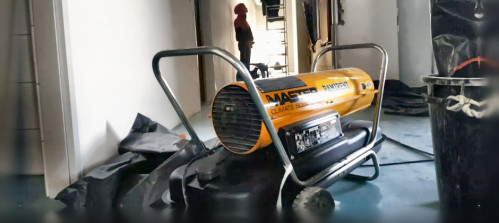
When do you need temporary heating?
Few people purchase a mobile heater permanently. They use it when there is still no heating, it is not enough or it is not working yet. Most often it is a building under construction, where plaster and screed need to be dried or concrete needs to be protected from frost. Just as often it is a hall, warehouse or workshop where the boiler has broken down or is being replaced and operation cannot wait for weeks.
The new hall also lacks heat before the heating is turned on. Outdoor events are a separate chapter: autumn markets, vintages and feasts, Christmas markets or concerts, where it gets cold quickly after sunset. The organizer then needs to heat the tent for guests and the production facilities, often only for a few days and in a location without a permanent connection.
With such a short-term deployment, something else is decisive than when designing permanent heating: how quickly you can bring the device and start it up, whether you have electricity on site, and whether people are in the space.
Infrared heater and hot air heater: two ways to bring warmth to people
Heat can reach you in two ways. Forced air heating heats the air that a fan circulates around the room, which gradually warms the walls, materials and you. Radiant heating works like the winter sun: infrared radiation, i.e. invisible heat rays, passes through the air with almost no loss and only heats the surface it hits.
In practice, this results in a completely different feeling. With a hot air heater, it takes a while for the entire volume to heat up, but then the heat is evenly distributed everywhere. You can feel the infrared heater almost immediately after switching it on, but only in the zone where it is directed.
For temporary heating, this has a practical consequence. If you need to dry out a building, protect materials from frost, or replace a malfunctioning heater, you need to heat the air and walls, i.e. the entire space. If you just want people to be warm while working, radiant heat in the workplace is enough. If you are also deciding on fuel, you can find an overview in our comparison of gas, diesel, and electric heaters .
Hall, workshop or structural building: when is it worth choosing which heater?
The decision mainly depends on what you need to heat, how high the space is and how often the door is opened. The table compares both methods in the situations for which mobile heating is most often sought.
| Criterion | Infrared heater (radiant heat) | Hot air heater |
| What heats | people, objects, surfaces | air throughout the space |
| Heat build-up | almost immediately in the irradiated zone | gradually according to volume and performance |
| High ceiling (over 6 m) | heat is directed towards the workplace | warm air accumulates under the roof |
| Open door, draft | heat loss is small | Heat escapes quickly |
| Drying plasters and screeds | inappropriate | suitable, ideal with dehumidification |
| Frost protection, winter concreting | only locally | suitable |
| Typical temporary deployment | workplace at the gate, ramp, outdoor workplace | a building, hall or workshop during a heating failure |
The comparison shows that in most situations, air heating wins for temporary heating. Both the building and the unheated hall need heat throughout their entire volume, and a mobile hot air heater will provide it without assembly.
A hall where the heating went out
If the heating in the hall fails permanently, the goal is to maintain operation until repairs are made, so that the pipes and goods do not freeze and people can continue working. In a high hall, warm air rises under the roof and can be several degrees colder at the floor. Therefore, direct the air flow from the heater to the floor and workplaces, or distribute it with hoses. An infrared heater is useful here as a supplement at workplaces near the gates, where warm air cannot last.
Workshop and construction in progress
Heating a workshop during a boiler replacement or heating a structural building is a typical task for a hot air heater. The volume is smaller, the air is heated quickly and the heat is distributed evenly.
Imagine that you are finishing the rough construction of a family house in November and the plasterers are due to arrive in two weeks. The building has windows, the heating is not yet turned on and it freezes overnight. An indirect combustion heater placed in front of the house blows dry warm air in through a hose and the flue gases remain outside. After starting the permanent heating, you simply return the heater.
What to do in a space that is ventilated or has an open door
In a building without doors or in a hall where trucks are constantly moving, the air changes very quickly. If you heat only by heating the air, you are literally heating the outside in such a space. The first step is therefore to divide the space into zones and cover the places where people stand for a long time with radiant heat.
Place the heater so that it does not blow directly into the door, but into the depth of the space. A ventilated space also has one advantage: it can withstand a direct-fired heater, which needs a constant supply of fresh air. Therefore , diesel heaters or propane-butane gas heaters are often used in such places.
Direct or indirect heating: where do the flue gases go?
Direct heating is used by direct-fired diesel heaters and propane-butane gas heaters. They do not have a chimney, so a fan blows heated air into the room along with flue gases: carbon dioxide, water vapor, and in case of poor combustion, carbon monoxide. Thanks to this, almost all the heat from the combustion remains in the room, but the flue gases must be removed by ventilation. Water vapor increases humidity, which is more likely to harm you when drying the building.
Indirect heating separates the flame from the air with a heat exchanger, a metal chamber that the flame heats from the inside. The flue gases are discharged through a chimney and clean, dry, odorless air flows into the space. The heater can also be placed outside the building and the heat is brought inside by air hoses. This option is suitable wherever people are present and the space is closed or poorly ventilated.
What heater power do you need to heat the space?
You can roughly determine the required heater power by multiplying the volume of the space in m³ by the difference between the outside and desired temperatures and the insulation coefficient, dividing the result by 860 to get kilowatts. The coefficient ranges from 0.6 for a well-insulated building to 3–4 for an uninsulated hall or a rough structure .
Step by step procedure:
- Multiply the length, width and height of the space in meters.
- Subtract the lowest expected outdoor temperature from the desired temperature.
- Choose a coefficient: 3.0–4.0 for an open or uninsulated building, 2.0–2.9 for a simple hall or masonry without insulation, 1.0–1.9 for a normally insulated building, 0.6–0.9 for a well-insulated one .
- Calculate: volume × temperature difference × coefficient ÷ 860
- Add a reserve of 10–20% for opening doors and gates
Example: a workshop 10 × 8 × 4 m has a volume of 320 m³. It is −5 °C outside and when working standing up, for example during assembly, according to Decree No. 99/2016 Coll., 15 °C is enough, so the difference is 20 °C. For a simple construction with a coefficient of 3, it comes out to 320 × 20 × 3 ÷ 860, or approximately 22 kW. With a reserve for opening the door, a diesel heater with an output of up to 29 kW is sufficient.
This calculation does not apply to an infrared heater, because it does not heat a volume, but an area. It is sized according to the size of the workplace and the distance from people. For a larger hall, it is worth using professional advice , which will suggest the number and placement of heaters.
Heating safety: distances, air and carbon monoxide
Temporary heating often runs in spaces it wasn't designed for, and sometimes overnight. You can prevent most accidents with three simple habits.
Clearances from flammable materials
The radiant source heats everything it points at, including wood, polystyrene, foils and tarpaulins. Distances vary depending on the manufacturer and power, so always follow the instructions; electric radiant heaters usually state a distance of at least 1 meter from flammable materials. Do not point the hot air heater's outlet at flammable materials and do not use it in an environment with sawdust or wood dust, which it can suck in and blow out when ignited.
Fresh air supply
Combustion consumes oxygen. A direct combustion heater therefore needs a constant supply of fresh air, never cover its intake and do not operate it in a building that is completely sealed with foil. Only refuel when the device is switched off.
Carbon monoxide detection
Carbon monoxide (CO) cannot be seen or smelled, and people often attribute the first symptoms of headache, dizziness and nausea to fatigue. Therefore, use a battery-operated CO detector with any combustion heater in an enclosed space. If the alarm sounds, turn off the heater, leave the area and ventilate thoroughly. Never leave a direct-fired heater in a room where someone is sleeping.
What does it look like in practice?
In practice, it often happens that the builder dries fresh screed with a direct-fired heater. However, the water vapor from the flue gases increases the humidity in the room and the drying process takes longer. Therefore, choose indirect heating for drying and regularly remove the humid air.
A common mistake is under-dimensioning the power. The heater runs continuously, consumes a lot of fuel, and the temperature does not rise anyway. Before renting, calculate the power and leave a reserve for opening the door.
During renovations, it is a good idea to consider temporary heating when planning the schedule. If plastering or screeding is going to take place in the winter, without heating, the work will be delayed or the material will not cure properly. Therefore, reserve the heater along with the other equipment.
What solutions can you find at Ramirenta?
Ramirent offers mobile hot air heaters for construction sites, halls and events, which you can rent for the exact time that heating is still missing. Diesel models with direct and indirect combustion reach an output of 200 kW and more, gas-powered propane-butane ones have 10–73 kW, and electric heaters do not produce exhaust gases.
As a guide, you can rent a direct-fired diesel heater up to 29 kW for €19 excluding VAT per day (€23.37 including VAT). The equipment will be delivered to your location by a technician and you will be assisted with the selection at any of the twelve branches .
Frequently asked questions
An infrared heater is worth it where you don't need to heat the entire space, but only to warm people in one place, for example a worker at the gate, on a ramp or in an outdoor workplace. You feel the heat immediately after switching it on and you don't lose it even when there is a draft or an open door. However, if you need to dry out a building, protect material from frost or maintain the temperature in the entire hall, a hot air heater remains a better choice.
An indirect-fired heater is a must for a closed tent where many people are staying. It is placed outside and the warm air is supplied through a hose, so that the exhaust fumes remain outside the tent. For open areas near the stands, entrance or stage, radiant heat is suitable, which will not be blown away by the wind. The heater requires electricity (230 V) to drive the fan, so check the connection in advance or count on a generator.
It depends on the power and thermostat setting. A heater up to 29 kW with direct combustion consumes 0.8–2.3 liters per hour, or approximately 6–18 liters for an eight-hour shift. A larger model with indirect combustion and a power of 47–81 kW has a consumption of 3.9–6.8 liters per hour.
It's not enough. Warm air will absorb moisture from plaster and screed, but if you don't remove it from the space, it will condense in cold places. Therefore, combine heating with short bursts of intensive ventilation or with dehumidifiers that capture the water directly.
Conclusion
Temporary heating has only one purpose: to bridge the time while permanent heating is missing or not working. A warm air heater is suitable for a construction site, workshop, hall or tent without heating, indirect combustion in a closed space with people, and radiant heat will supplement workplaces with open doors. Always calculate the power and don't forget a CO detector.
See the complete offer in the Energy, Heating and Lighting category and choose a heater for rent that fits your space perfectly.