


How to treat wood before winter: fence, terrace and gazebo in 6 steps
A wooden deck left unprotected for the winter will spend several months in a cycle of rain, frost and thaw. Water will seep into the pores, freeze at night and in the spring you will find gray, cracked boards with peeling paint. We will show you how to treat the wood on your fence, deck or gazebo before the frost: when you can do it, how to prepare the surface and which paint to choose.

Why September to October is the last window for painting
The weather affects the result as much as the coating itself. Stain manufacturers state a minimum of +5 °C for the air, the painted wood and the material itself. Some products require up to +10 °C. The optimum is 15–25 °C and a relative humidity of 40–80%.
In Slovakia, these conditions reliably apply in September and October. In November, it is already freezing in the morning, fog lingers during the day, and the wood does not have time to dry. Painting wood in the fall has one advantage over summer: the sun is not scorching, so the glaze does not dry too quickly and soaks in better.
When preparing the garden for winter, most people think of leaves, hedges and the last mowing. Wooden structures are often missing from this list. Extending the life of wooden structures depends mainly on the condition in which they enter the winter.
How do you know if wood is dry enough to paint?
Wood is ready for painting when its moisture content does not exceed 15% for coniferous trees and 12% for deciduous trees. The most reliable way to check this is with a needle moisture meter, which you insert into the wood in several places. Without a device, the rule of thumb is: wait at least 2–3 dry days after rain and paint only after the morning dew has disappeared.
Measure especially where water stays the longest: at the bottom of the fence boards, where it meets the grass, at the ends of the boards and under the flower pots on the patio. If the moisture meter shows more than the paint manufacturer allows, wait, even if the top surface looks dry.
Freshly processed wood contains about half of the water. Therefore, do not paint a new fence or gazebo made of wet lumber immediately after assembly. We also describe why wood needs air and time to dry in our article on how to build a shed in which wood dries .
Surface preparation: washing, removing old paint, sanding
Even the best stain won't last if you apply it over dust, algae, or loose old paint. Preparation takes more time than the actual painting. But it's what makes the difference between a single winter and several seasons.
Washing the terrace and fence
First, remove moss, green algae and stubborn dirt. For larger surfaces, a high-pressure cleaner will save you hours of scrubbing. However, for wood, work with lower pressure, a flat nozzle and from a distance of more than 30 cm, always in the direction of the grain. Too strong a jet at close range will disintegrate the wood and leave the surface hairy.
Tip: Before you start cleaning the entire patio, test the pressure and distance in a small, less visible area (e.g. in a corner).
After washing, let the wood dry thoroughly. Check the moisture content again before proceeding, as washed boards will absorb more water than you might expect.

Old paint and how to paint varnished wood
A cohesive old glaze coat can be cleaned and sanded. Cracked or peeling paint must be removed completely, otherwise the new layer will fall off along with the old.
A common question is how to paint varnished wood. Varnish creates a sealed film on the surface that neither stain nor oil can soak into. If the varnish is intact, sand it down to a matte finish and apply a coat of the same type. If it is cracking, remove it completely. For straight fence or railing boards, a 100 mm belt sander is suitable, as it will quickly remove both the old paint and varnish.
Sanding of wooden fence and terrace
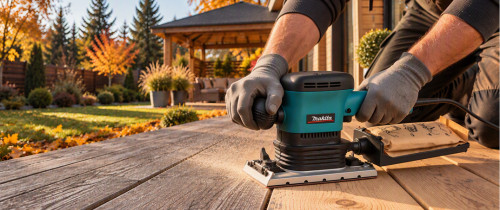
Sand smooth wood in the direction of the grain with 80–120 grit paper. This will open the pores and help the paint adhere better. When sanding a wooden fence with many battens, you will appreciate a lightweight orbital sander that can reach the edges and corners. You can find an overview of types in the sanders for rent category.
Sanding creates fine dust that can irritate your eyes and respiratory tract. Wear a respirator and safety glasses, and with a belt sander that produces 82 dB of noise, wear ear protection. Always connect the sander to a dust extraction or industrial vacuum cleaner, otherwise the dust will get caught in the new paint.

Stain, oil or topcoat: when to use which
If you're wondering what wood stain is: it's a semi-transparent coating that partially soaks into the wood, preserving its texture and protecting it from water and UV rays. The oil penetrates deeper and doesn't form a film on the surface. The topcoat completely covers the wood and creates an impermeable layer.
When deciding how to treat wood, the chart will help you choose based on what you are painting and how often you want to repaint.
| Paint | Appearance | Where it fits best | Orientation restoration | What to watch out for |
| Thin-layer glaze | Visible wood grain, subtle shade | Fences, pergolas, gazebos | 2–5 years | The colorless version provides poor UV protection |
| Thick-layer glaze | Drawing visible, slight shine | Windows, doors, gazebo cladding | 5–8 years | It gets scuffed on walking surfaces |
| Terrace oil | Natural, matte | Terraces, garden furniture | 1× per year | Requires regular maintenance |
| Covering paint | Opaque, uniform color | Old and damaged wood, fences | 5–8 years, some more | More sanding is needed when restoring |
The comparison shows a simple rule. Oil belongs on the terrace you walk on, because it doesn't peel off and you don't have to sand down to clean wood when renovating. Stain will protect the fence and gazebo. If the wood is already visually tired, a top coat will hide stains and uneven graying.
Apply impregnation to new, untreated wood before staining. Impregnation of wooden fences and terraces protects the wood from the inside against fungi, mold, and wood-destroying insects, while the top coat protects it from the outside.
Coating process and number of coats
Once the surface is dry, clean and sanded, you can finish painting in one to two days. It is important to follow the order of the steps and give each layer time.
- Choose at least two rain-free days with temperatures above the manufacturer's recommended limit.
- Cover paving, plants and metal elements.
- Soak the new wood with impregnation and let it dry.
- Apply the first layer with a brush in the direction of the fibers, first on the fronts and edges of the boards.
- Follow the drying time according to the instructions, usually 6–24 hours for glazes.
- If the fibers have lifted, sand the surface with 240–280 grit fine paper.
- Apply a second layer, and a third on exposed areas.
Manufacturers recommend 2–3 coats of stain for exteriors. Apply the oil in thin layers and wipe off any excess that doesn't soak in with a rag after a while. Apply from late morning to early afternoon so the paint dries before the evening dew falls.
What to do with grayed or cracked wood
The gray color of wood does not mean that it is rotten. UV radiation breaks down lignin, the substance that holds the fibers together, and rain gradually washes it away. This leaves a thin gray layer on the surface, on which no paint will last long.
Grayed wood
If you are considering how to treat wood that has already turned gray, start by removing the gray layer. Sand down to healthy, light wood. For larger areas, a de-graying agent, a special cleaner for grayed wood, will also help, which you can then wash off with water. Only then proceed with impregnation and coating.
Restoration of a wooden terrace with cracks
Fine hairline cracks in the direction of the grain are common in exterior wood and will be sealed with paint. Check for deeper cracks with a knife: if the wood softens and crumbles, it is rotting and the board should be replaced. Tighten any loose screws, otherwise water will be trapped in the holes.
Imagine a cottage with a 20 m² spruce terrace that has not been painted for several years. On Saturday morning, you wash it with a high-pressure washer and let it dry. On Sunday, you sand the gray layer and replace two rotten boards. Two days later, when the wood is dry, you apply two coats of decking oil. Renting a decking washer costs €19 excluding VAT per day and a vibratory sander costs €8 excluding VAT per day, which is a fraction of the price of replacing the entire terrace.
What solutions can you find at Ramirenta?
Once you know how to treat wood, all that remains is to figure out the technique. To prepare wood before painting, you don't have to buy machines that you'll use once every few years. In Ramirenta, in the hand tools category, you can rent an orbital sander for fine sanding and a belt sander for removing old paint. In small mechanization, you can find high-pressure washers and industrial vacuum cleaners , which are suitable for washing the terrace and for extracting dust during sanding.
If you are not sure which machine is right for your wood or surface, seek professional advice . The branch will help you choose the right equipment and accessories, such as sandpaper of the appropriate grit.
Frequently asked questions
Pressure-treated wood is protected against rot and insects, but not against UV rays and cracking, and will gradually turn gray without a coating. To preserve the color and reduce absorbency, coat it with oil or stain. This is usually done after a few weeks to months, when the impregnation in the wood has dried.
Not right away. The oil stays in the pores and the stain wouldn't stick to such a surface. Clean the wood thoroughly first and sand it down to clean wood, or stick with oil, which can be easily restored with another coat.
Shovel snow with a plastic shovel, as the metal edge will damage the paint and wood. Do not spread salt on the terrace, which dries out the wood and damages its surface. Place flower pots on pads so that water does not stand under them.

CONCLUSION
Treat the wood no later than October, when it is dry and the outside temperature is consistently above +5 °C. Most of the success comes from surface preparation: washing, removing old paint and sanding. Choose oil for the terrace, and stain or topcoat for the fence and gazebo, and always apply at least two coats.